Welcome to Visit Site Radar Walak Papua Network

Latest Post

Tampilkan postingan dengan label Melanesia Posts. Tampilkan semua postingan

Perjalanan Menuju Jantung Papua: Lembah Baliem (Heart of Papua)

Written By Anonim on Senin, 16 Juni 2014 | 6/16/2014 01:08:00 AM

Perjalanan Menuju Jantung Papua: Lembah Baliem (Heart of Papua)

Wamena - Perjalanan menuju Lembah Baliem yang terletak di lereng Pegunungan Jayawijaya, Papua, seperti mimpi jadi nyata. Inilah tempat wisatawan mengenal akar dari seluruh budaya yang tersebar di Papua.


Awan pagi itu tak ubahnya kapas raksasa yang mengambang di angkasa. Bandara Frans Kaisiepo di Biak mulai disinari cahaya mentari, berpendar keemasan, menggantikan malam yang sudah habis. Selasa (7/8/2012), saya tiba di Biak dengan perasaan gembira. Ada "butterfly in my stomach", sesuatu yang menggelitik di sanubari, membuat senyum di bibir ini tak kunjung berhenti.


Biak bukanlah tujuan saya kali ini. Bandara Frans Kaisiepo hanya menjadi saksi transit, menyambut sekaligus mengantar saya menuju wilayah yang lebih timur lagi: Papua.


Setelah 9 jam penerbangan dari Jakarta dengan transit di Makassar, tujuan pesawat Merpati yang saya tumpangi adalah Bandara Sentani di Jayapura. Setelah itu, maskapai Trigana Air akan menjadi tempat saya mengadu nasib menuju Bandara Wamena.


Dalam tiket berwarna merah bertuliskan "Trigana Air Service", saya mengetahui nomor tempat duduk lewat coretan "37" yang ditulis dengan spidol biru. Bagian dalam pesawat itu cukup mungil, dengan tempat duduk 2-2. Lalu saya bingung, tak ada kursi nomor 37!


Satu-satunya pramugari yang bertugas kali itu memanggil saya untuk menduduki kursi paling depan. Saat itulah saya sadar, ternyata nomor kursi tak berlaku di sini.


Sebelum lepas landas, Kasubdit Wisata Wilayah Maluku & Papua dari Kemenparekraf, Maria Mayabubun, sempat memberitahu saya sesuatu. Apa yang dibisikkannya hanya membuat saya makin tergelitik, pun menjadikan "butterfly in my stomach" ini semakin terasa.Next 


Jalan menuju lokasi festival (Sastri/ detikTravel)

Rate And Identification Melanesians

Written By MELANESIA POST on Minggu, 10 November 2013 | 11/10/2013 07:25:00 PM

Rate And Identification Melanesians
Race Melanesian Identification
 
A. LAY Melanesians
Melanesia has an area 5,600 km. From northwest to southeast, Melanesia consists of: Papua New Guinea, Papua, West Papua, Maluku, North Maluku, East Nusa Tenggara And East Timor, Solomon Islands, Fiji Islands, Caedonia Island, and some of the island state of Vanuatu. Is the largest island in Melanesia New Guinea. The largest island in the Pacific islands and the world's second largest island after Greenland. Eastern and southern New Guenea is Solomon and Venuatu country, and the islands of Fiji. There are more than 700 languages ​​here.

2. POPULATION AND culture MELANESIA
 
Although there is a diversity of native banayak in Melanesia, as a whole, the people there were black and curly berambutt. New Guinea native tribes migrated migrated to the island take more than 30,000 years ago. The second group, Papuan tribes, dominated the population in New Guinea. The third group is the ethnic Melanesians, who inhabit prtama times and are indigenous Melanesians who inhabit the southern tip of the island of New Guinea and some of her Melanesia. All three ethnic groups, a descendant Austroloid race inhabiting Australia and some famil of Southeast Asia. Yan is not dark-skinned race that was in the Melanesian region could we meet in Fiji, who have lighter skin that we usually encounter in the Polynesian region. Also, some residents Fuji also comes from Indian tribes brought by anatara British ships in 1979 and 1916 to work on sugar cane pergebunan. Most inhabitants of Melanesia berkehidupan embrace farming and highly patriarchal culture.
 
 
3.AGAMA INDIGENOUS CULTURE IN MELANESIA
In Melanesian culture, we can   take the case of Malind Anim tribe in Maroke City, Tanah Papua, the so-called traditional religions are the things that deal with Indigenous issues.
For example: if you   Pahas surname from the village of Gebze, Muting District, and in touch with relatives Marga Marga or the other, then the most important matters in it is a matter of kinship or village land as well as matters relating to the affairs of collective ownership in closely related genera earlier.
The Landlord usually share some of their traditional communal areas to a number of people who called clan relatives to stay and also take the results of the hamlet of parts communal land owned by Landlord. However, the right of ownership is based on the understanding that the land was the one who had voluntarily had given to the clan relatives to be controlled and processed for the needs of daily living. Or it could also be exchanged with the provision of the child, as the child of peace, which will be binding on kinship ties in closely related genera earlier. Events like this have a lot going on, not just in the habit of Malind Anim tribe but also Papuan tribes lainnya.contoh case of Malind Anim tribe were merely examples of intermediaries so that we can understand exactly what is meant by what to do with the clan and clan kinship and its relationship with the tribe and the nation as a whole.
Traditionally Malind Anim tribe is divided into three sub-tribe known as the cult Malind Bob Mayo, Malind DUV with Imo cult, and the cult Malind degh-Uzum Ezam.
The third stream of traditional beliefs had to be a point where the ecosystem civilization built Malind Anim. If I am a sub-tribe of Anim Malind Malind degh, then I would interpret my spiritual relationship with what I know as Ezam-Uzum, as well as Bob and Malind Malind DUV.
Kinship as described above is also built on the assumption that sub-tribe cultural ecosystem was housed and clans formed therein traditional governance based on the above assumptions.
In Melanesian culture, the principle of things, especially with regard to land rights is a fundamental principle that the existence of clans and tribes at stake, and indigenous religions in principle fully supports the rights of the collective ownership of tribal clans in question.
Compared with Celestial Religion, promised land, as depicted in the Bible, also has the same meaning, as I have explained about the collective ownership of land rights by a particular clan within the tribe, I take the example of earlier parts of the city Maroke Malind Anim.
Customary rights, in the future, a problem that is so complex, to produce a never-ending war, for example, Israel Modern Nation, which was built on land that is called "the Promised Land!" On one hand went well, and is able to satisfy the tastes and political humor the Jews, but on the other hand also the expense of other tribes and nations.
The Palestinians as an obvious example is the victim of the seizure of birthright or customary rights as contained in the Holy Scriptures.
Primary data which are in the Bible, showing with certainty that what is happening in Israel and Palestine, is not supposed to happen like this, because the struggle for the birthright or customary rights had been causing a prolonged war between the people of Israel with the backing of Western Christians and Muslims Muslims on the other diseantoro the Arabian Peninsula and the Maghreb, and even extends to Southeast Asia, where Indonesia is known as the largest Muslim country in the world, is also soluble in the political arena earlier political battle, even puritanical Islamic militancy wake up and be fertile in Indonesia Indonesia as the lair of the "terrorists" in Western terminology.


MELANESIA

 MELANESIA

Melanesia United Nations Islands
Melanesia ( from Greek " black island " ) is a territory that extends from the western Pacific to the Arafura Sea , north and northeast of Australia . The term was first used by French explorer Jules Dumont d' Urville in 1832 to refer to an ethnic group and the grouping of islands distinct from Polynesia and Micronesia . Nowadays , the classification of " racial " Dumont d' Urville is considered inappropriate because he covered the cultural diversity , linguistic , and genetic Melanesia and now it is only used for geographical naming .Countries that belong to the Melanesian namely :

The Melanesian delegation

Written By MELANESIA POST on Sabtu, 09 November 2013 | 11/09/2013 08:07:00 PM

The Melanesian delegation

While West Papuan independence groups appeal for international recognition, Jakarta is fighting to retain control of the region


Melanesian politics are rarely a concern for the world’s emerging powers. For the Indonesian government, however, they have become a matter of grave importance.

The Melanesian delegation
Strength in numbers:
Some 2,000 Papuans march to demand a referendum on self-determination in 2010

The Melanesian Spearhead Group (MSG) – an intergovernmental organisation composed of Fiji, Vanuatu, Papua New Guinea, Solomon Islands and the FLNKS, an alliance of political parties in New Caledonia – has promised to send a mission to West Papua, Indonesia’s resource-rich, easternmost region. On the agenda will be assessing whether the West Papua National Coalition for Liberation (WPNCL) should be allowed to join the MSG – something Jakarta would prefer to avoid.

West Papua is a part of Indonesia, but the WPNCL, an umbrella group of dozens of West Papuan organisations, campaigns for the region’s independence. Indonesia’s history is littered with separatist plays, and Jakarta fears nothing more than the breakup of the republic. MSG membership could serve as a stepping stone for West Papua’s addition to the United Nations’ list of countries yet to be decolonised, an unprecedented acknowledgement by the international community that its people have been deprived of their right to self-determination. The 1969 Act of Free Choice, a UN-sponsored referendum in which West Papuans were supposedly able to choose whether to join Indonesia or form their own country, is widely regarded as a sham.

The MSG already considered the coalition’s bid, but its foreign ministers elected, at Jakarta’s behest, to defer a decision until they could see for themselves the situation in West Papua. At the 19th MSG Leaders’ Summit, held in mid-June in Noumea, New Caledonia, they announced they would form a delegation to visit Jakarta and then West Papua before the end of the year. The stated aim was to investigate whether West Papuans really are victims of human rights abuses and economic marginalisation. There is a long history in Indonesia of vicious acts committed by the security forces and of wealth flowing inordinately from the archipelago’s peripheries to Java and Jakarta in the centre.

Jakarta was relieved by the deferral. It now has the chance to state its case on its own turf. “[Jakarta] was likely aiming to create a situation where they could control what data was provided to the MSG regarding [West] Papua,” Selpius Bobii, a Papuan political prisoner, wrote in Scoop Media. “It’s going to be absolutely critical that the [delegation] in their visit… show extreme caution and a highly selective process in their acceptance of data and information.”

The interim might also give Indonesia time to influence the course of events in other ways. Jakarta will probably use it to try to buy off Melanesian political leaders, according to Jason MacLeod, a University of Queensland professor and a research fellow with the West Papua Project at the Centre for Peace and Conflict Studies at the University of Sydney. “I think we are likely to see financial inducements offered to MSG nations in the form of bilateral agreements and aid,” he said.
The Melanesian delegation
Up in arms: The prime minister of Fiji, Voreqe Bainimarama, has close military ties with Indonesia

The MSG members seem divided in their stances. Fijian Prime Minister Voreqe Bainimarama enjoys close military ties with the Indonesian government, and recently there have been high-level visits, MacLeod said. In Papua New Guinea, there is a split between Peter O’Neill, the current prime minister, and Michael Somare, the previous one. While Somare, a guest of honour at the June summit, said that he backed West Papuan membership, O’Neill did not even attend. Instead, he visited Jakarta, concluding the trip by telling reporters that West Papua was an integral part of Indonesia.

Solomon Islands Prime Minister Gordon Lilo said at the summit that “the West Papuan case is an incomplete decolonisation issue… it must be resolved now”, according to a WPNCL statement. But in August, Lilo told journalists after a meeting with Indonesian President Susilo Bambang Yudhoyono in Jakarta that he was “quite impressed with the [ongoing] progress in Papua”. He also visited West Papua but, to MacLeod’s knowledge, did not meet with any political prisoners or resistance leaders. Last month it came to light that Jakarta had paid for the trip, giving Lilo’s government $171,000.

There is a chance Jakarta will try to head off the MSG delegation by inviting the ministers on a series of individual, bilateral visits, according to MacLeod. “After several visits by single foreign ministers, the Indonesian government could claim a multilateral visit is not necessary,” he said. “The danger is that the MSG foreign ministers could write their report advising on the decision of West Papuan membership to the MSG without any genuine input from Papuan civil society.”

The other two MSG members seem less vulnerable to such overtures. The FLNKS (Kanak and Socialist Nationalist Liberation Front, a political coalition from New Caledonia, whose multi-party government is divided over whether the territory should push for independence from France) is seeking support for its own decolonisation campaign. Indeed, it was the FLNKS that invited the WPNCL to attend the summit.
In Vanuatu, the issue of Papuan decolonisation has risen further up the national agenda than in any other country. In 2010 its parliament passed a unanimous motion to take the matter up with the UN. At the June summit, Vanuatu’s prime minister, Moanna Carcassas, said that the country would not be free until all of Melanesia was free: “I say that we as brothers must stand for [West Papua]. The epicentre of support for the advocacy for West Papuan self-determination must begin in this region – Melanesia – and from here it could spread to other foreign lands.”

That is exactly what Jakarta does not want to happen. The lengths it will go to to prevent it remain to be seen. Already, foreign journalists are effectively banned from West Papua. Reporters will undoubtedly seek to accompany the MSG mission, but the rules are justified by a supposed threat to their safety. Leaked military documents, however, show that Jakarta is more worried about international opinion toward West Papua than about militants. Secret files that surfaced in 2010 said that the “separatist political movement” which had “reached the outside world” was “much more dangerous” than armed groups that “hardly do anything”.

This is not the first time Jakarta has had to decide how to handle journalists reporting on a foreign delegation it would rather not accommodate. In 1991, Portugal planned a fact-finding mission to East Timor, its former colony, to determine whether the people there were content with Indonesian rule. The delegation was cancelled after Jakarta objected to the inclusion of Jill Jolliffe, an Australian reporter who it regarded as pro-independence. “They said the journalist was not serving the purpose of the visit,” said Andreas Harsono, a Jakarta-based researcher with Human Rights Watch. “The purpose of the visit was for the Portuguese delegation to see things getting better in East Timor.”

The East Timorese went ahead with a massive demonstration anyway; more than 200 protesters were killed. But an English reporter filmed the carnage, and the video he smuggled out was broadcast across the world. That was when the international movement for East Timor really took off.
A similar incident in West Papua, known as the Biak massacre, produced a different result. In 1998 soldiers opened fire on Papuans as they demonstrated in Biak, killing dozens. “There were no outsiders there to witness it,” MacLeod said. “West Papua is a secret story.”

Jakarta is already selling the MSG ministers its own version of the West Papuan story. The WPNCL may never get to tell its side.

Papuan cultural rallies held across West Papua and Indonesia

Papuan cultural rallies held across West Papua and Indonesia

August 16, 2013
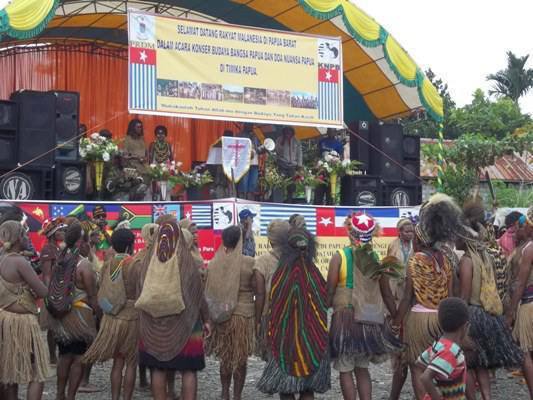
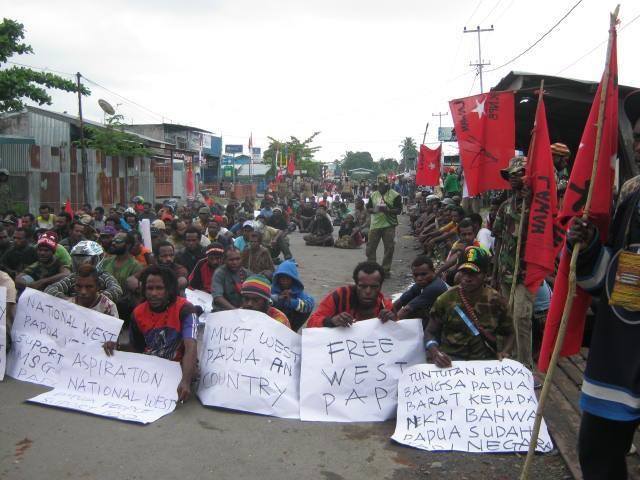
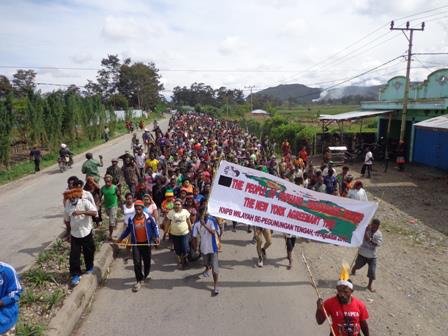
cultural rally tiikaOn 15th August 2013, in rejection of the so called “New York Agreement”, in support of West Papua joining the Melanesian Spearhead Group and in support of the new Free West Papua Campaign office opening in the Netherlands, mass Cultural Parade rallies were held all over West Papua and throughout Indonesia.

Despite the police ban on the demonstrations and heavy police presence, including tanks, demonstrations went ahead peacefully in Nabire, Timika, Jayapura, Biak and Jakarta.
In an interview with Radion New Zealand (RNZI) the West Papua National Coalition for Liberation’s Paula Makabory told Johnny Blades the demonstrations appear to have proceeded harmoniously.

PAULA MAKABORY: And in fact even though eight people were arrested on the preparations for the rally yesterday before on the 13th August but yesterday they keep doing the rally and also some students from AMP organisations and KNPB were together they did the rally as well in the city of Java.
JOHNNY BLADES: So it sounds like there wasn’t an excessive response from the security forces?
cultural rallyPM: Yeah I think there is no shooting and they didn’t stop the rally even though the police banned it so the main point is you can see how strong the West Papuan would like to stand up to spread the message out here and their rights, especially the right to self-determination. They all stand up also for the same message to support the opening office of the Free West Papuan movement in the Hague, in the Netherlands.

JB: And do you think that the Indonesian security forces are becoming a bit more reasonable in their approach, in their response to these sorts of occasions?
PM: I think after Indonesia being criticised at the UN critical reviews of the Human Rights Committee this is like a positive attitude, while really on the ground, you cannot control them. So for me you cannot say yes or no to these situations because they can do anything anywhere anytime to the West Papuan.
JB: There’s a cultural element to a lot of these demonstrations in that they are displaying their Melanesia roots.
cultural rally2PM: Yeah I think the message is quite strong and especially it was done yesterday in memory of that New York Agreement back in the 15th of August 1962 where I think the claims of the West Papuan there is really strong which is they would like to know the legality of this agreement. Then the legality of the Act Of Free Choice back in 1969 and the legality of the Freeport McMoRan deal even before the Act Of Free Choice took place. And here on this ground in West Papua with all the cultural rallies yesterday with the strong support and calling for the right to self-determination of the West Papuan they would like to show the whole region of Pacific Islands or Melanesian countries and the world that they still don’t think that they belong under Indonesian rule.

Organisa Papua Merdeka (OPM) Dapat Dukungan Dari Negara-Negara Melanesia

Written By MELANESIA POST on Rabu, 06 November 2013 | 11/06/2013 05:36:00 AM

 
JAKARTA, PESATNEWS- Organisasi Persatuan antarnegara Melanesia atau Melanesian Spearhead Group (MSG) memberikan pengakuan dan dukungan terhadap kemerdekaan Papua Barat. Hal tersebut dilontarkan oleh Sekretaris Jenderal West Papua National Coalition for Liberation Rex Rumikek.

"Pengakuan Melanesian Spearhead Group (MSG) atas Papua Barat lebih penting daripada keanggotaan," ujar Rex, seperti dikutip Radio Australia, Rabu (26/6/2013).

Menurut Rex kelompok MSG melakukan pertemuan di Kaledonia Baru pekan lalu. Dalam pertemuan itu, MSG mengakui keberadaan Papua Barat dan menerima permohonan keanggotan dari aktivis Papua itu.

"Dalam komunike akhir mereka, para pemimpin Melanesia mendukung hak yang tak dapat dipungkiri dari rakyat Papua Barat untuk menentukan nasib sendiri," lanjutnya.

Sebelumnya, pelobi Papua Andy Ayamiseba mengatakan, bila aplikasi keanggotaan diterima maka bisa meningkatkan status Papua Barat yang ingin memerdekakan diri dari Indonesia.

Beberapa waktu lalu, Organisasi Papua Merdeka (OPM) mendapatkan dukungan dari pemerintah kota Oxford, Inggris. Bendera OPm bebas berkibar di salah satu kota besar Inggris tersebut.

WEST PAPUA UJIAN BAGI NEGARA-NEGARA UJUNG TOMBAK MELANESIA

WEST PAPUA UJIAN BAGI NEGARA-NEGARA UJUNG TOMBAK MELANESIA


The Voice Of Melanesia Nations For West Papua
Jayapura, 14/8 (Melanesi Post)-Selama tiga hari PM Kepulauan Solomon Gordon Darcy Lilo berkunjung ke Indonesia. Ia sudah berada di Bogor pada Senin(12/8) dan telah melakukan pertemuan bilateral dengan Presiden Republik Indonesia, Susilo Bambang Yudhoyono.

Lilo menegaskan kunjungannya ke Indonesia atas undangan dari Pemerintah Indonesia untuk menerima informasi seputar kemajuan dan perkembangan di Papua serta kerja sama ekonomi.
Kepulauan Solomon, Fiji, Vanuatu, PNG dan FLNKS dari Kanak Caledonia Baru termasuk negara-negara Ujung Tombak Melanesia yang mengundang WPNCL dari West Papua untuk hadir dalam MSG Summit di Noumea, belum lama ini.

Berikut tabloidjubi.com mencoba mengangkat potensi sumber daya alam mineral di PNG dan Provinsi Papua  termasuk bagaiman mengangkat nilai-nilai Melanesia menurut mantan PM Vanuatu Walter Lini. Melanesian way mulai berkembang sejak 1970 an hingga awal 1980 an di mana Walter Lini sebagai salah satu pencetusnya.

Papua New Guinea (PNG) dan Provinsi Papua satu daratan yang memiliki tambang emas terbesar saat ini. Hanya saja potensi itu belum dimanfaatkan secara maksimal bagi kemakmuran masyarakat di Melanesia. Ujung tombak negara Melanesia, termasuk wilayah yang kaya akan sumber daya alam termasuk potensi perikanan terbesar di dunia.

Bayangkan demam emas pertama kali melanda PNG sejak 1878 di Port Moresby, eksploitasi yang berlebihan oleh Inggris dan Australia hingga sekarang ini. Sedangkan di Papua Barat secara intensip dilakukan oleh PT Freeport Indonesia pada 1973. Bahkan pejabat berwenang di PNG berani mengatakan mereka menargetkan akan menjadi salah satu penghasil emas terbesar di dunia.

Berdasarkan pengalaman  di PNG, saat demam emas  melanda wilayah Port Moresby dan Bulolo, orang mulai menyadari bahwa setidaknya gunung-gunung di Papua Barat (Provinsi Papua dan Papua Barat) yang berbatasan langsung dengan PNG seperti OK Tedi Mining diduga terdapat kandungan emas di Pegunungan Bintang, Papua Barat.

Papua New Guinea(PNG) termasuk negara Ujung Tombak Melanesia yang memiliki potensi sumber daya mineral terbesar di antara sesama negara Melanesia. Sumber mineral terbesar adalah tembaga dan emas yang menyumbang sekitar 60 % eksport PNG sejak 1989 hingga saat ini. Potensi ini belum termasuk sumber daya minyak dan LNG. Tambang terbesar jelas terdapat di Bougainville dan OK Tedi Mining.

Bukan hanya  wilayah itu saja yang diduga memiliki potensi tambang dan mineral tetapi Sungai Frieda, demikian pula di dekat Madang Province. Potensi gas alam dan minyak bumi juga ditemukan di Teluk Papua.
Bagaimana dengan wilayah Melanesia lainnya seperti Solomon Island, Fiji, New Caledonia dan Vanuatu? Jelas agak berbeda jauh dengan PNG yang memiliki dataran lebih luas ketimbang negara-negara Melanesia tersebut.

Vanuatu yang baru merdeka pada 30 Juli 1980  termasuk salah satu negara yang mendorong solidaritas sesama Ujung Tombak Melanesia dimotori oleh mantan PM Vanuatu Walter Lini. Mantan Perdana Menteri Vanuatu inilah yang mensponsori berdirinya Ujung Tombak Melanesia pada Maret 1988 di Port Villa.

Menurut Walter Lini nilai-nilai Melanesia adalah merupakan kepercayaan budaya dari rakyatnya. Bagi Walter Lini nilai-nilai Melanesia merupakan kebalikan dari nilai-nilai kapitalis, komunalisme versus individualisme. Berbagi(sharing) versus kepentingan pribadi, dan kemanusiaan versus materialisme.

Komunalisme dalam budaya Melanesia didasarkan pada kesadaran masyarakat di mana individu tidak melihat dirinya atau kepentingan pribadinya harus diutamakan daripada kepentingan bersama masyarakat. Atau tidak ada kepentingan pribadi setiap suku tetapi yang ada hanya kepentingan klen di dalam kebudayaan Melanesia.

Menurut Walter Lini sharing memiliki hubungan erat dengan prinsip memberi dan menerima dalam kebudayaan Melanesia, “memberi berdasarkan kemampuan seseorang, dan menerima berdasarkan kebutuhan seseorang.” Kemanusiaan lanjut Walter Lini jelas  menunjuk kepada “rasa kasih”(affection) dan “tolong menolong”(mutual help). Dengan demikian menurut Lini Melanesian Way adalah komunalisme, sharing dan kemanusiaan.

Melanesian way juga berkembang dengan pesat awal 1970 an ketika PNG hendak merdeka dari penjajahan pemerintahan Australia, 16 September 1975. Saat itu muncul gerakan-gerakan radikal yang  menentang kolonialisme dan menuntut kemerdekaan PNG. Idelogi kaum nasionalis PNG lebih banyak tercermin dalam istilah Melanesian Way.

Walter Lini menyadari betapa pentingnya membangkitkan kembali kebudayaan Melanesia, yang disebut sebagai Melanesia Renaissance. Ini berarti lanjut Lini harus menunjuk kepada kelahiran kembali identitas dan tujuan kita, serta memelihara, dan tanpa mecegah hak yang diberikan Tuhan kepada kita untuk membangun dengan cara kita dan sesuai dengan nilai-nilai dan harapan-harapan kita. (B.M.Kilungga)


Organisasi Antar-Negara Melanesia Akui Papua Barat


Organisasi Antar-Negara Melanesia Akui Papua Barat

The Voice Melanesia Nation
MELANESIA - Organisasi antarnegara Melanesia atau Melanesian Spearhead Group (MSG) memberikan pengakuan terhadap Papua Barat. Hal tersebut dilontarkan oleh Sekretaris Jenderal West Papua National Coalition for Liberation Rex Rumikek. "Pengakuan Melanesian Spearhead Group (MSG) atas Papua Barat lebih penting dari pada keanggotaan," ujar Rex, seperti dikutip Radio Australia, Rabu (26/6/2013).

Menurut Rex kelompok MSG melakukan pertemuan di Kaledonia Baru pekan lalu. Dalam pertemuan itu, MSG mengakui keberadaan Papua Barat dan menerima permohonan keanggotan dari aktivis Papua itu.

"Dalam komunike akhir mereka, para pemimpin Melanesia mendukung hak yang tak dapat dipungkiri dari rakyat Papua Barat untuk menentukan nasib sendiri," lanjutnya.

Sebelumnya, pelobi Papua Andy Ayamiseba mengatakan, bila aplikasi keanggotaan diterima maka bisa meningkatkan status Papua Barat yang ingin memerdekakan diri dari Indonesia.

Sementara usai pertemuan MSG tersebut Rex menyebutkan, "Menjadi anggota tidak terlalu penting karena itu hanya suatu jembatan bagi kami untuk menuju ke PBB. Itu juga penting, tapi yang paling penting adalah pengakuan dari anggota-anggota PBB dan Australia bahwa isu Papua Barat, hak kami untuk menentukan nasib sendiri."

MSG adalah lembaga internasional yang terdiri dari empat negara Melanesia. Negara yang tergabung dalam organisasi ini antara lain Fiji, Papua Nugini, Kepulauan Solomon dan Vanuatu serta satu partai dari Kaledonia Baru.

Pertama kali dibentuk, lembaga ini tidak lebih sebagai pertemuan politik pada 1983 lalu. Pada 23 Maret 2007, anggota MSG menandatangani pembentukan MSG dan membawa kelompok itu di bawah payung hukum internasional dan memiliki markas di Port Vila, Vanuatu.

The Voice Of Melanesia Nation - Melanesia Kelompok Wilayah bukan Identitas

The Voice Of Melanesia Nation

The Voice Of Melanesia Nations
Nama Melanesia (dari bahasa Yunani: hitam; Yunani: pulau) pertama kali digunakan oleh Jules Dumont d’Urville pada 1832 untuk  menunjukkan suatu pengelompokan etnis dan geografis pulau-pulau yang berbeda dari Polinesia dan Mikronesia. Daerah yang termasuk dalam Melanesia adalah Fiji, Papua New Guinea, Kepulauan Salomon, Vanuatu, Kaledonia Baru, Maluku dan Maluku Utara, Nusa Tenggara Timur, Papua dan Papua Barat. Terdapat komunitas antar negara Melanesia yang didirikan pada 23 maret 2013 antara lain Fiji, Papua New Guinea, Kepulauan Salomon dan Vanuatu yang terletak di wilayah samudera pasifik. komunitas antar negara ini di beri nama Melanesian Spearhead Group (MSG) bermarkas di Port Vila-Vanuatu.

Papua adalah Indonesia
Pada saat berbicara tentang Melanesia maka Papua memang termasuk dalam kawasan Melanesia namun tetap berada pada nauangan NKRI. Terkadang terdapat salah persepsi dari beberapa kelompok di Papua yang mengatakan Papua adalah Melanesia maka pantas untuk memisahkan diri, padahal Papua pada saat ini sedang berada pada fase Krisis identitas yang tak terkendali, sehingga berlaku berlebihan untuk mempertegas eksistensi dirinya. Krisis identitas yang terjadi di Papua diakibatkan beberapa factor seperti ketidakmampuan untuk bersaing dalam berbagai bidang, semakin pesatnya perkembangan arus globalisasi dan pembangunan daerah yang cenderung lambat. Permasalahan krisis identitas tidak hanya di hadapi orang-orang Papua namun di seluruh Indonesia seperti kata almarhum Gus Dur Bangsa Indonesia krisis identitas. Pluralisme yang menjadi alasan berdirinya NKRI (Negara Kesatuan Republik Indonesia), terancam . hal ini belum di sadari oleh beberapa kelompok di Papua bahwa sebenarnya permasalahan yang di hadapi di Papua juga di hadapi oleh masyarakat Indonesia secara keseluruhan.

Papua sebuah Identitas
Indonesia terdiri dari berbagai suku dan bahasa termasuk Papua namun Indonesia tetap satu seperti semboyan kita yaitu Bhineka Tunggal Ika (berbeda-beda tetapi tetap satu), itulah keunikan Indonesia yang harus tetap di pertahankan karena keunikan itulah salah satu identitas Indonesia. bagaimanapun alasannya Papua tetap bagian NKRI yang harus sama-sama kita bangun. pembangunan berlandaskan Pancasila bukan hanya membangun secara fisik tetapi juga membangun secara mental. Seperti kata Bung Karno Bangunlah suatu dunia di mana semua bangsa hidup dalam damai dan persaudaran mari kita bangun bangsa Bhineka Tunggal Ika itu tanpa kata Melanesia ataupun melayu.

The Voice Of Melanesia Nations For West Papua

Written By MELANESIA POST on Selasa, 05 November 2013 | 11/05/2013 06:29:00 AM

Mayoritas di Melanesia mendukung kemerdekaan Papua Barat

The Voice Of Melanesia Nations For West Papua
Sebagai pemimpin berkumpul di Fiji minggu ini untuk Melanesian Spearhead Group (MSG) Leaders Summit, Pasifik Institut Kebijakan Publik (PIPP) telah merilis temuan dari pertama jajak pendapat melalui telepon yang pernah dilakukan di seluruh Melanesia.
Tujuh pertanyaan yang berkaitan dengan "Melanesia keluarga" negara yang diajukan, termasuk satu meminta yang besar "non pulau Pasifik" negara dianggap mitra terbaik bagi masing-masing negara di wilayah tersebut. Pemimpin MSG dapat didorong bahwa mayoritas (74,9%) responden menyadari badan regional untuk mewakili Melanesia.
Ketika ditanya siapa mereka dianggap sebagai bagian dari keluarga Melanesia, mayoritas yang jelas responden termasuk anggota didirikan (PNG, Kepulauan Solomon, Vanuatu, Fiji dan Kaledonia Baru), sementara 42% juga termasuk Papua Barat, 17,1% termasuk Australia, 14,9% termasuk Indonesia dan 14,1% termasuk Timor Leste.
Pertanyaan lain yang diajukan adalah "Apakah Anda mendukung kemerdekaan bagi Papua Barat?" Sebuah mayoritas responden di seluruh Melanesia mengatakan ya, dengan dukungan yang sangat tinggi di PNG (89,3%) dan Vanuatu (88,2%). Hal ini menunjukkan keterputusan antara dukungan rakyat dan posisi yang diambil oleh pemerintah di wilayah tersebut, kecuali Vanuatu, yang telah lama diperjuangkan Barat penyebab Papua pada tingkat politik.
Diminta untuk menghubungkan hubungan antara negara mereka dan Australia, mayoritas responden mengatakan hal itu positif kecuali yang berada di Fiji. Australia juga dianggap sebagai mitra eksternal yang terbaik untuk PNG (40,5%) dan Solomon (40,4%), sedangkan untuk Vanuatu hanya 14,1% responden menganggap Australia terbaik, sedangkan China mencetak 32,9%. Di antara responden di Fiji ada perasaan bahwa itu dianggap Australia, Selandia Baru, Cina dan AS karena semua kira-kira sama pentingnya.
Sehubungan dengan keterlibatan dengan Fiji, mayoritas responden termasuk di Fiji sendiri, memilih untuk meningkatkan keterlibatan atau menjaga tingkat keterlibatan seperti itu. Pandangan yang diungkapkan oleh responden jajak pendapat ini dapat membantu para pemimpin MSG karena mereka membahas tentang masa depan daerah ini.