Welcome to Visit Site Radar Walak Papua Network

Latest Post

Tampilkan postingan dengan label Voice of Pacific Islands. Tampilkan semua postingan

Rate And Identification Melanesians

Written By MELANESIA POST on Minggu, 10 November 2013 | 11/10/2013 07:25:00 PM

Rate And Identification Melanesians
Race Melanesian Identification
 
A. LAY Melanesians
Melanesia has an area 5,600 km. From northwest to southeast, Melanesia consists of: Papua New Guinea, Papua, West Papua, Maluku, North Maluku, East Nusa Tenggara And East Timor, Solomon Islands, Fiji Islands, Caedonia Island, and some of the island state of Vanuatu. Is the largest island in Melanesia New Guinea. The largest island in the Pacific islands and the world's second largest island after Greenland. Eastern and southern New Guenea is Solomon and Venuatu country, and the islands of Fiji. There are more than 700 languages ​​here.

2. POPULATION AND culture MELANESIA
 
Although there is a diversity of native banayak in Melanesia, as a whole, the people there were black and curly berambutt. New Guinea native tribes migrated migrated to the island take more than 30,000 years ago. The second group, Papuan tribes, dominated the population in New Guinea. The third group is the ethnic Melanesians, who inhabit prtama times and are indigenous Melanesians who inhabit the southern tip of the island of New Guinea and some of her Melanesia. All three ethnic groups, a descendant Austroloid race inhabiting Australia and some famil of Southeast Asia. Yan is not dark-skinned race that was in the Melanesian region could we meet in Fiji, who have lighter skin that we usually encounter in the Polynesian region. Also, some residents Fuji also comes from Indian tribes brought by anatara British ships in 1979 and 1916 to work on sugar cane pergebunan. Most inhabitants of Melanesia berkehidupan embrace farming and highly patriarchal culture.
 
 
3.AGAMA INDIGENOUS CULTURE IN MELANESIA
In Melanesian culture, we can   take the case of Malind Anim tribe in Maroke City, Tanah Papua, the so-called traditional religions are the things that deal with Indigenous issues.
For example: if you   Pahas surname from the village of Gebze, Muting District, and in touch with relatives Marga Marga or the other, then the most important matters in it is a matter of kinship or village land as well as matters relating to the affairs of collective ownership in closely related genera earlier.
The Landlord usually share some of their traditional communal areas to a number of people who called clan relatives to stay and also take the results of the hamlet of parts communal land owned by Landlord. However, the right of ownership is based on the understanding that the land was the one who had voluntarily had given to the clan relatives to be controlled and processed for the needs of daily living. Or it could also be exchanged with the provision of the child, as the child of peace, which will be binding on kinship ties in closely related genera earlier. Events like this have a lot going on, not just in the habit of Malind Anim tribe but also Papuan tribes lainnya.contoh case of Malind Anim tribe were merely examples of intermediaries so that we can understand exactly what is meant by what to do with the clan and clan kinship and its relationship with the tribe and the nation as a whole.
Traditionally Malind Anim tribe is divided into three sub-tribe known as the cult Malind Bob Mayo, Malind DUV with Imo cult, and the cult Malind degh-Uzum Ezam.
The third stream of traditional beliefs had to be a point where the ecosystem civilization built Malind Anim. If I am a sub-tribe of Anim Malind Malind degh, then I would interpret my spiritual relationship with what I know as Ezam-Uzum, as well as Bob and Malind Malind DUV.
Kinship as described above is also built on the assumption that sub-tribe cultural ecosystem was housed and clans formed therein traditional governance based on the above assumptions.
In Melanesian culture, the principle of things, especially with regard to land rights is a fundamental principle that the existence of clans and tribes at stake, and indigenous religions in principle fully supports the rights of the collective ownership of tribal clans in question.
Compared with Celestial Religion, promised land, as depicted in the Bible, also has the same meaning, as I have explained about the collective ownership of land rights by a particular clan within the tribe, I take the example of earlier parts of the city Maroke Malind Anim.
Customary rights, in the future, a problem that is so complex, to produce a never-ending war, for example, Israel Modern Nation, which was built on land that is called "the Promised Land!" On one hand went well, and is able to satisfy the tastes and political humor the Jews, but on the other hand also the expense of other tribes and nations.
The Palestinians as an obvious example is the victim of the seizure of birthright or customary rights as contained in the Holy Scriptures.
Primary data which are in the Bible, showing with certainty that what is happening in Israel and Palestine, is not supposed to happen like this, because the struggle for the birthright or customary rights had been causing a prolonged war between the people of Israel with the backing of Western Christians and Muslims Muslims on the other diseantoro the Arabian Peninsula and the Maghreb, and even extends to Southeast Asia, where Indonesia is known as the largest Muslim country in the world, is also soluble in the political arena earlier political battle, even puritanical Islamic militancy wake up and be fertile in Indonesia Indonesia as the lair of the "terrorists" in Western terminology.


MELANESIA

 MELANESIA

Melanesia United Nations Islands
Melanesia ( from Greek " black island " ) is a territory that extends from the western Pacific to the Arafura Sea , north and northeast of Australia . The term was first used by French explorer Jules Dumont d' Urville in 1832 to refer to an ethnic group and the grouping of islands distinct from Polynesia and Micronesia . Nowadays , the classification of " racial " Dumont d' Urville is considered inappropriate because he covered the cultural diversity , linguistic , and genetic Melanesia and now it is only used for geographical naming .Countries that belong to the Melanesian namely :

The Melanesian delegation

Written By MELANESIA POST on Sabtu, 09 November 2013 | 11/09/2013 08:07:00 PM

The Melanesian delegation

While West Papuan independence groups appeal for international recognition, Jakarta is fighting to retain control of the region


Melanesian politics are rarely a concern for the world’s emerging powers. For the Indonesian government, however, they have become a matter of grave importance.

The Melanesian delegation
Strength in numbers:
Some 2,000 Papuans march to demand a referendum on self-determination in 2010

The Melanesian Spearhead Group (MSG) – an intergovernmental organisation composed of Fiji, Vanuatu, Papua New Guinea, Solomon Islands and the FLNKS, an alliance of political parties in New Caledonia – has promised to send a mission to West Papua, Indonesia’s resource-rich, easternmost region. On the agenda will be assessing whether the West Papua National Coalition for Liberation (WPNCL) should be allowed to join the MSG – something Jakarta would prefer to avoid.

West Papua is a part of Indonesia, but the WPNCL, an umbrella group of dozens of West Papuan organisations, campaigns for the region’s independence. Indonesia’s history is littered with separatist plays, and Jakarta fears nothing more than the breakup of the republic. MSG membership could serve as a stepping stone for West Papua’s addition to the United Nations’ list of countries yet to be decolonised, an unprecedented acknowledgement by the international community that its people have been deprived of their right to self-determination. The 1969 Act of Free Choice, a UN-sponsored referendum in which West Papuans were supposedly able to choose whether to join Indonesia or form their own country, is widely regarded as a sham.

The MSG already considered the coalition’s bid, but its foreign ministers elected, at Jakarta’s behest, to defer a decision until they could see for themselves the situation in West Papua. At the 19th MSG Leaders’ Summit, held in mid-June in Noumea, New Caledonia, they announced they would form a delegation to visit Jakarta and then West Papua before the end of the year. The stated aim was to investigate whether West Papuans really are victims of human rights abuses and economic marginalisation. There is a long history in Indonesia of vicious acts committed by the security forces and of wealth flowing inordinately from the archipelago’s peripheries to Java and Jakarta in the centre.

Jakarta was relieved by the deferral. It now has the chance to state its case on its own turf. “[Jakarta] was likely aiming to create a situation where they could control what data was provided to the MSG regarding [West] Papua,” Selpius Bobii, a Papuan political prisoner, wrote in Scoop Media. “It’s going to be absolutely critical that the [delegation] in their visit… show extreme caution and a highly selective process in their acceptance of data and information.”

The interim might also give Indonesia time to influence the course of events in other ways. Jakarta will probably use it to try to buy off Melanesian political leaders, according to Jason MacLeod, a University of Queensland professor and a research fellow with the West Papua Project at the Centre for Peace and Conflict Studies at the University of Sydney. “I think we are likely to see financial inducements offered to MSG nations in the form of bilateral agreements and aid,” he said.
The Melanesian delegation
Up in arms: The prime minister of Fiji, Voreqe Bainimarama, has close military ties with Indonesia

The MSG members seem divided in their stances. Fijian Prime Minister Voreqe Bainimarama enjoys close military ties with the Indonesian government, and recently there have been high-level visits, MacLeod said. In Papua New Guinea, there is a split between Peter O’Neill, the current prime minister, and Michael Somare, the previous one. While Somare, a guest of honour at the June summit, said that he backed West Papuan membership, O’Neill did not even attend. Instead, he visited Jakarta, concluding the trip by telling reporters that West Papua was an integral part of Indonesia.

Solomon Islands Prime Minister Gordon Lilo said at the summit that “the West Papuan case is an incomplete decolonisation issue… it must be resolved now”, according to a WPNCL statement. But in August, Lilo told journalists after a meeting with Indonesian President Susilo Bambang Yudhoyono in Jakarta that he was “quite impressed with the [ongoing] progress in Papua”. He also visited West Papua but, to MacLeod’s knowledge, did not meet with any political prisoners or resistance leaders. Last month it came to light that Jakarta had paid for the trip, giving Lilo’s government $171,000.

There is a chance Jakarta will try to head off the MSG delegation by inviting the ministers on a series of individual, bilateral visits, according to MacLeod. “After several visits by single foreign ministers, the Indonesian government could claim a multilateral visit is not necessary,” he said. “The danger is that the MSG foreign ministers could write their report advising on the decision of West Papuan membership to the MSG without any genuine input from Papuan civil society.”

The other two MSG members seem less vulnerable to such overtures. The FLNKS (Kanak and Socialist Nationalist Liberation Front, a political coalition from New Caledonia, whose multi-party government is divided over whether the territory should push for independence from France) is seeking support for its own decolonisation campaign. Indeed, it was the FLNKS that invited the WPNCL to attend the summit.
In Vanuatu, the issue of Papuan decolonisation has risen further up the national agenda than in any other country. In 2010 its parliament passed a unanimous motion to take the matter up with the UN. At the June summit, Vanuatu’s prime minister, Moanna Carcassas, said that the country would not be free until all of Melanesia was free: “I say that we as brothers must stand for [West Papua]. The epicentre of support for the advocacy for West Papuan self-determination must begin in this region – Melanesia – and from here it could spread to other foreign lands.”

That is exactly what Jakarta does not want to happen. The lengths it will go to to prevent it remain to be seen. Already, foreign journalists are effectively banned from West Papua. Reporters will undoubtedly seek to accompany the MSG mission, but the rules are justified by a supposed threat to their safety. Leaked military documents, however, show that Jakarta is more worried about international opinion toward West Papua than about militants. Secret files that surfaced in 2010 said that the “separatist political movement” which had “reached the outside world” was “much more dangerous” than armed groups that “hardly do anything”.

This is not the first time Jakarta has had to decide how to handle journalists reporting on a foreign delegation it would rather not accommodate. In 1991, Portugal planned a fact-finding mission to East Timor, its former colony, to determine whether the people there were content with Indonesian rule. The delegation was cancelled after Jakarta objected to the inclusion of Jill Jolliffe, an Australian reporter who it regarded as pro-independence. “They said the journalist was not serving the purpose of the visit,” said Andreas Harsono, a Jakarta-based researcher with Human Rights Watch. “The purpose of the visit was for the Portuguese delegation to see things getting better in East Timor.”

The East Timorese went ahead with a massive demonstration anyway; more than 200 protesters were killed. But an English reporter filmed the carnage, and the video he smuggled out was broadcast across the world. That was when the international movement for East Timor really took off.
A similar incident in West Papua, known as the Biak massacre, produced a different result. In 1998 soldiers opened fire on Papuans as they demonstrated in Biak, killing dozens. “There were no outsiders there to witness it,” MacLeod said. “West Papua is a secret story.”

Jakarta is already selling the MSG ministers its own version of the West Papuan story. The WPNCL may never get to tell its side.

Papuan cultural rallies held across West Papua and Indonesia

Papuan cultural rallies held across West Papua and Indonesia

August 16, 2013
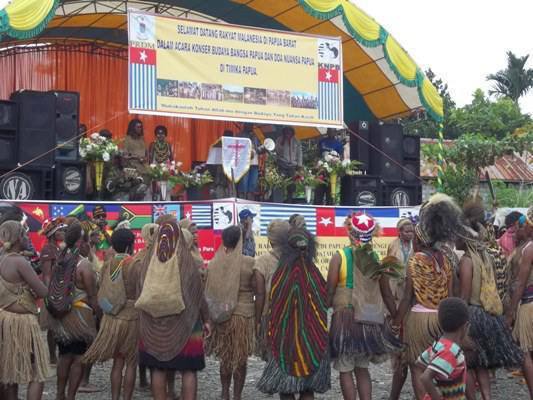
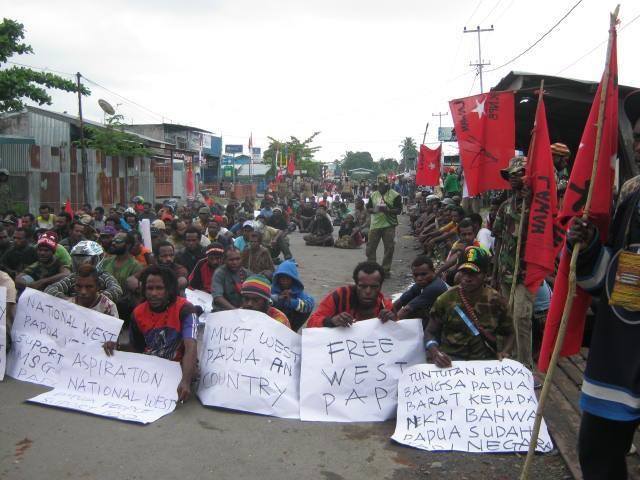
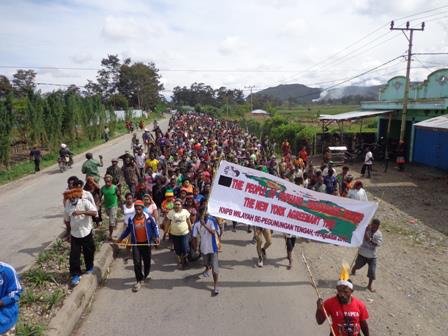
cultural rally tiikaOn 15th August 2013, in rejection of the so called “New York Agreement”, in support of West Papua joining the Melanesian Spearhead Group and in support of the new Free West Papua Campaign office opening in the Netherlands, mass Cultural Parade rallies were held all over West Papua and throughout Indonesia.

Despite the police ban on the demonstrations and heavy police presence, including tanks, demonstrations went ahead peacefully in Nabire, Timika, Jayapura, Biak and Jakarta.
In an interview with Radion New Zealand (RNZI) the West Papua National Coalition for Liberation’s Paula Makabory told Johnny Blades the demonstrations appear to have proceeded harmoniously.

PAULA MAKABORY: And in fact even though eight people were arrested on the preparations for the rally yesterday before on the 13th August but yesterday they keep doing the rally and also some students from AMP organisations and KNPB were together they did the rally as well in the city of Java.
JOHNNY BLADES: So it sounds like there wasn’t an excessive response from the security forces?
cultural rallyPM: Yeah I think there is no shooting and they didn’t stop the rally even though the police banned it so the main point is you can see how strong the West Papuan would like to stand up to spread the message out here and their rights, especially the right to self-determination. They all stand up also for the same message to support the opening office of the Free West Papuan movement in the Hague, in the Netherlands.

JB: And do you think that the Indonesian security forces are becoming a bit more reasonable in their approach, in their response to these sorts of occasions?
PM: I think after Indonesia being criticised at the UN critical reviews of the Human Rights Committee this is like a positive attitude, while really on the ground, you cannot control them. So for me you cannot say yes or no to these situations because they can do anything anywhere anytime to the West Papuan.
JB: There’s a cultural element to a lot of these demonstrations in that they are displaying their Melanesia roots.
cultural rally2PM: Yeah I think the message is quite strong and especially it was done yesterday in memory of that New York Agreement back in the 15th of August 1962 where I think the claims of the West Papuan there is really strong which is they would like to know the legality of this agreement. Then the legality of the Act Of Free Choice back in 1969 and the legality of the Freeport McMoRan deal even before the Act Of Free Choice took place. And here on this ground in West Papua with all the cultural rallies yesterday with the strong support and calling for the right to self-determination of the West Papuan they would like to show the whole region of Pacific Islands or Melanesian countries and the world that they still don’t think that they belong under Indonesian rule.

Pacific Voices Feature

Pacific Voices Feature

Pacific Voices Feature

Conversations held at the recent Australasian Law Reform Associations’ Conference in Canberra prompted a discussion as to whether institutional law reform (i.e. law reform as carried out by a dedicated agency such as a law reform commission) is really practicable within the context of small jurisdictions such as those that make up the greater part of the Pacific island region. Read Tess Newton Cain’s analysis here.

POLICY, PAPERS AND PAGES – Feature

POLICY, PAPERS AND PAGES – Feature

POLICY, PAPERS AND PAGES – Feature

PiPP research associate Toby Ley’s paper, entitled ‘Policy, Papers and Pages‘ explores the interplay between media and democracy in the South Pacific. The paper draws upon interviews conducted with five Pacific media professionals and proposes a more strategic struggle for media freedom in the region. The paper was presented at the Media and Democracy in the South Pacific symposium held at the University of the South Pacific.
Posted under Features  |  No Comments

Reporting the Pacific’s climate plight

Reporting the Pacific’s climate plight

Reporting the Pacific’s climate plight

The 2nd Edition of the Climate Vulnerability Monitor was launched last month on the sidelines of the 67th Session of the United Nations General Assembly. The Monitor has sobering figures: 5 million people are currently estimated to die annually due to climate change and the carbon economy, 100 million people are expected to die by the end of the next decade, and under the most likely parameters the monetary cost is expected to reach 3.2 per cent of GDP by 2030.

Developing countries will face the majority of these impacts, and Pacific states are amongst the nations facing the most severe costs relative to GDP.


The report was commissioned by the Climate Vulnerability Forum (CVF), a bloc of countries – including Kiribati, Timor-Leste, Tuvalu and Vanuatu – identifying themselves as being ‘among the most vulnerable to the adverse impacts of climate change’. The CVF uses its collective voice to push for stronger action in the international system, and has been active in the UN system, including at Rio+20 and the climate change conferences, since its establishment in 2009.

The Monitor provides a global overview of the current and future costs in 2030 resulting from both climate change (such as sea level rise and droughts) and impacts of the carbon economy (for example, indoor pollution and oil spills). These costs are broken down into a number of categories in the report: industry change, natural disasters, habitat change and health impacts.

From this wide-scale assessment, the Monitor has successfully illustrated how pervasive and expensive the impacts of climate change and carbon pollution are globally. While global reports are useful for rallying support at important international meetings, such as the upcoming Doha Climate Change Conference, the Monitor lacks detail and is probably inaccurate at the country level in the Pacific.

The Pacific features prominently in the CVF, yet the region’s plight is poorly articulated by this report.
For example, Kiribati is predicted to have one death per year in 2030 due to climate change induced hunger. And perhaps more erroneously, this report suggests that there will be no increase in hunger mortality from the current estimate, also at one death per year.

When I travelled to Kiribati last month on a research assignment for PiPP, I was told that there were people being hospitalised because they were malnourished. Determining the cause of current hunger is difficult, but one does not require advanced statistical models to postulate that hunger will increase due to climate change in Kiribati.

While data in Pacific microstates is notoriously difficult to come by, inaccurate estimations may result in resource allocations away from the most pertinent issues if domestic decisions are made based on the data from influential reports such as this. From a cursory glance, there appear to be a number of other poorly substantiated estimations on other Pacific island countries, and the use of more accurate, up-to-date data would help improve the legitimacy of future Monitor reports. This weak approach towards the Pacific is not unique to the Monitor, but is symptomatic of the focus given to our region in most international reports.

Often it seems that the Pacific is tacked onto Asia for no better reason than hyphenation. Globally focused reports are useful, particularly for global collective action issues such as climate change, but care ought to be taken when assessing specific regions, sub-regions, and states.
Different sections of the report are available, and the full report can be read here [36 MB].

New Flags Flying: Pacific Leadership

New Flags Flying: Pacific Leadership

New Flags Fliting Pacific Leadership
In an article that I wrote about ‘nation-building and identity in Melanesia’ I put forward the notion that after 30 years of independence, building states in the Melanesian region is a process that goes beyond governance and globalisation to include history and culture. Nation building projects are an evolving phenomenon and modern state systems are relatively new and culturally foreign. In this context, the transition from custom economies and societies to modern nation states presents a myriad of challenges and conflicts. New Flags Flying: Pacific leadership is a valuable work that offers rare, insiders´ perspectives of these challenges and canvasses the journeys to independence for fourteen Pacific countries through the lenses of Pacific leaders. The book was launched in the region at the Pacific Forum Secretariat in Suva, Fiji on 9 October 2012.

Background work on the book began around 1992 when Ian Johnstone, a broadcaster/writer, began gathering interviews with leaders from Samoa, Cook Islands, Tonga, Papua New Guinea, Solomon Islands and Vanuatu. In 2009,  in response to concerns  relayed by Pacific island students, on ‘how difficult it  is to find information about the recent history of their countries’  Johnstone, in  partnership with Michael Powles – a former senior diplomat- looked at ways to make the leadership interviews more widely and easily available. Initially the interviews were assembled into seventeen-part website and later transformed into a 328 page collection including pictures, maps, brief background information on each country and an audio CD with 20 interviews with Pacific leaders.

Fourteen chapters of the book are dedicated to presenting the conversations held with Pacific leaders recounting historical information relating to the various transitions from colonies to independent or self-governingstates.  Pacific leaders interviewed include Tui AtuaTupuaTamaseseTa´isi Efi and Tofilau Eti Alesana (Samoa); John Webb and Sir Tom Davis (Cook Islands); Dr Ludwig Keke (Nauru); HM King Taufa´ahauTupou IV (Tonga); Ratu Sir Kamisese Mara (Fiji); Mititaiagimene Young Vivian and Robert Rex (Niue); Sir Michael Somare (Papua New Guinea); Solomon Mamaloni and Sir Peter Kenilorea (Solomon Islands); Hon. Bikenibeu Paeniu (Tuvalu); Sir Leremia Tabai (Kiribati); Fr Walter Lini (Vanuatu); John Haglelgam  (Federated States of Micronesia); Kessai Note (Marshall Islands);  and Sandra Sumang Pierantozzi (Palau).

Through their stories, they share personal reflections on hard-won insights on leadership, how they managed to achieve their goals and lessons learned in the process. Apart from Tonga, the only Pacific country never colonised, these Pacific island leaders poignantly describe the treatment and attitudes of colonial powers and the moves they made on the way to self-government and independence. Pacific leaders also share personal insights relating their hopes, fears and challenges lying ahead in achieving a truly independent future. Ratu Sir Kamisese Mara for example, had no sense that the colonial period was ending, acknowledging, ‘we were part of the Queen´s regnum; we were happy – why should we change things?’ (p95).Bikenikbeu Paeniu expressed reservations about his country becoming independent, saying, ‘no time from nation-building, for planning at all… we know in those days Britain was letting go their colonies, the empire was breaking down’ (p171). Others such as Samoa and Cook islands wanted self-government as soon as possible and Fr. Walter Lini expressed a strong desire to give freedom to the Ni-Vanuatu people, stating ‘we wanted to make sure we did not lose our land in Vanuatu, that´s why we struggled … It was easy to achieve independence because we had a common cause, but it was more difficult to govern because we had not experienced the art of decision-making…”(p213).

A particularly interesting chapter is dedicated to womens’ perspectives of leadership in the Pacific. The authors point out that ‘across the pacific, male domination of politics had long been the norm, which is not to say that women were without authority’ (p266). This is portrayed through the traditional role of women in different parts of the region and in the stories of Hon. Fiame Na Fiame Naomi Mata´afa, a Samoa MP since 1975. She says, ‘in Samoa we don´t believe there should be parliamentary seats set aside for women’ (p267) and Dame Carol Kidu former MP remarked on Papua New Guinea that, ‘women are powerful in the private sphere, very powerful, but that power was not translated into the public sphere… and this is where we´ve got to make that quantum leap, to give women the space in the public sphere’ (p283).

The final chapter reflects on the interviews and summarises these Pacific voices on the challenges of decolonisation, aid and governance, leadership and political systems and mentions the ‘old flags’ that are still flying in the Pacific. Some Pacific people are still aspiring for independence such as the indigenous Kanak of New Caledonia. This book provides a fascinating portal into the past that will enrich the perspectives of students, academics and professionals interested in the Pacific and beyond.

The Mountain – Drusilla Modjeska

The Mountain – Drusilla Modjeska


Just lately everyone seems to be talking about ‘The Mountain’ by Drusilla Modjeska . It is a story of love, identity, power and relationships set against the enthralling backdrop of pre-independence and modern day Papua New Guinea. How, if at all, does it speak to the people of the Pacific? Linda Kenni, research officer at PiPP, gives us her thoughts here…. Read more

Pacific Islands Forum 2013

Pacific Islands Forum 2013

PIF-blog-2
Pacific leaders are now gathering in Majuro, Marshall Islands for the annual Pacific Island Forum (PIF) meeting. This year’s summit is expected to focus on climate change leadership, the Pacific Plan and the ongoing issue of Fiji’s suspended membership. Follow our full coverage of this summit here and at pacificpolitics.com.