While West Papuan independence groups appeal for international recognition, Jakarta is fighting to retain control of the region
Melanesian politics are rarely a concern for the world’s emerging powers. For the Indonesian government, however, they have become a matter of grave importance.

Strength in numbers:
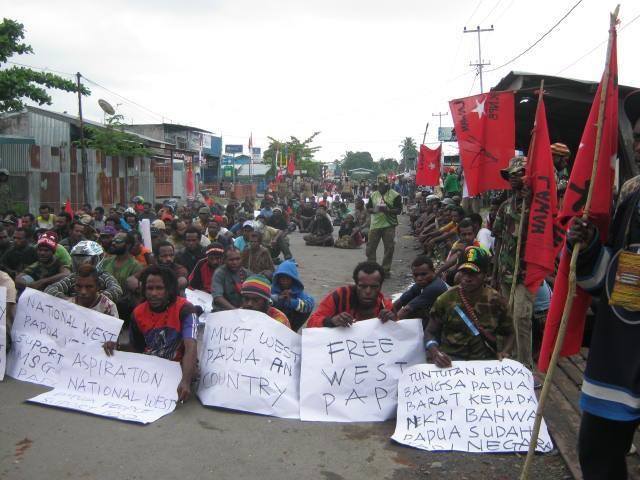
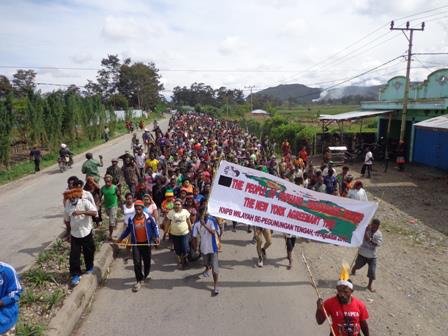
Some 2,000 Papuans march to demand a referendum on self-determination in 2010
The
Melanesian Spearhead Group (MSG) – an intergovernmental
organisation composed of Fiji, Vanuatu, Papua New Guinea, Solomon
Islands and the
FLNKS, an alliance of political parties in New Caledonia
– has promised to send a mission to
West Papua, Indonesia’s
resource-rich, easternmost region. On the agenda will be assessing
whether the West Papua National Coalition for Liberation (WPNCL) should
be allowed to join the MSG – something Jakarta would prefer to avoid.
West Papua is a part of Indonesia, but the
WPNCL, an umbrella group
of dozens of West Papuan organisations, campaigns for the region’s
independence. Indonesia’s history is littered with separatist plays, and
Jakarta fears nothing more than the breakup of the republic.
MSG
membership could serve as a stepping stone for West Papua’s addition to
the United Nations’ list of countries yet to be decolonised, an
unprecedented acknowledgement by the international community that its
people have been deprived of their right to self-determination. The 1969
Act of Free Choice, a UN-sponsored referendum in which West Papuans
were supposedly able to choose whether to join Indonesia or form their
own country, is widely regarded as a sham.
The
MSG already considered the coalition’s bid, but its foreign
ministers elected, at Jakarta’s behest, to defer a decision until they
could see for themselves the situation in West Papua. At the 19th MSG
Leaders’ Summit, held in mid-June in Noumea, New Caledonia, they
announced they would form a delegation to visit Jakarta and then West
Papua before the end of the year. The stated aim was to investigate
whether West Papuans really are victims of human rights abuses and
economic marginalisation. There is a long history in Indonesia of
vicious acts committed by the security forces and of wealth flowing
inordinately from the archipelago’s peripheries to Java and Jakarta in
the centre.
Jakarta was relieved by the deferral. It now has the chance to state
its case on its own turf. “[Jakarta] was likely aiming to create a
situation where they could control what data was provided to the MSG
regarding [West] Papua,” Selpius Bobii, a Papuan political prisoner,
wrote in Scoop Media. “It’s going to be absolutely critical that the
[delegation] in their visit… show extreme caution and a highly selective
process in their acceptance of data and information.”
The interim might also give Indonesia time to influence the course of
events in other ways. Jakarta will probably use it to try to buy off
Melanesian political leaders, according to Jason MacLeod, a University
of Queensland professor and a research fellow with the West Papua
Project at the Centre for Peace and Conflict Studies at the University
of Sydney. “I think we are likely to see financial inducements offered
to MSG nations in the form of bilateral agreements and aid,” he said.

Up in arms: The prime minister of Fiji, Voreqe Bainimarama, has close military ties with Indonesia
The
MSG members seem divided in their stances. Fijian Prime Minister
Voreqe Bainimarama enjoys close military ties with the Indonesian
government, and recently there have been high-level visits, MacLeod
said. In Papua New Guinea, there is a split between Peter O’Neill, the
current prime minister, and Michael Somare, the previous one. While
Somare, a guest of honour at the June summit, said that he backed West
Papuan membership, O’Neill did not even attend. Instead, he visited
Jakarta, concluding the trip by telling reporters that West Papua was an
integral part of Indonesia.
Solomon Islands Prime Minister Gordon Lilo said at the summit that
“the West Papuan case is an incomplete decolonisation issue… it must be
resolved now”, according to a WPNCL statement. But in August, Lilo told
journalists after a meeting with Indonesian President Susilo Bambang
Yudhoyono in Jakarta that he was “quite impressed with the [ongoing]
progress in Papua”. He also visited West Papua but, to MacLeod’s
knowledge, did not meet with any political prisoners or resistance
leaders. Last month it came to light that Jakarta had paid for the trip,
giving Lilo’s government $171,000.
There is a chance Jakarta will try to head off the MSG delegation by
inviting the ministers on a series of individual, bilateral visits,
according to MacLeod. “After several visits by single foreign ministers,
the Indonesian government could claim a multilateral visit is not
necessary,” he said. “The danger is that the MSG foreign ministers could
write their report advising on the decision of West Papuan membership
to the MSG without any genuine input from Papuan civil society.”
The other two
MSG members seem less vulnerable to such overtures. The
FLNKS (Kanak and Socialist Nationalist Liberation Front, a political
coalition from New Caledonia, whose multi-party government is divided
over whether the territory should push for independence from France) is
seeking support for its own decolonisation campaign. Indeed, it was the
FLNKS that invited the
WPNCL to attend the summit.
In Vanuatu, the issue of Papuan decolonisation has risen further up
the national agenda than in any other country. In 2010 its parliament
passed a unanimous motion to take the matter up with the UN. At the June
summit, Vanuatu’s prime minister, Moanna Carcassas, said that the
country would not be free until all of Melanesia was free: “I say that
we as brothers must stand for [West Papua]. The epicentre of support for
the advocacy for West Papuan self-determination must begin in this
region – Melanesia – and from here it could spread to other foreign
lands.”
That is exactly what Jakarta does not want to happen. The lengths it
will go to to prevent it remain to be seen. Already, foreign journalists
are effectively banned from West Papua. Reporters will undoubtedly seek
to accompany the
MSG mission, but the rules are justified by a supposed
threat to their safety. Leaked military documents, however, show that
Jakarta is more worried about international opinion toward West Papua
than about militants. Secret files that surfaced in 2010 said that the
“separatist political movement” which had “reached the outside world”
was “much more dangerous” than armed groups that “hardly do anything”.
This is not the first time Jakarta has had to decide how to handle
journalists reporting on a foreign delegation it would rather not
accommodate. In 1991, Portugal planned a fact-finding mission to East
Timor, its former colony, to determine whether the people there were
content with Indonesian rule. The delegation was cancelled after Jakarta
objected to the inclusion of Jill Jolliffe, an Australian reporter who
it regarded as pro-independence. “They said the journalist was not
serving the purpose of the visit,” said Andreas Harsono, a Jakarta-based
researcher with Human Rights Watch. “The purpose of the visit was for
the Portuguese delegation to see things getting better in East Timor.”
The East Timorese went ahead with a massive demonstration anyway;
more than 200 protesters were killed. But an English reporter filmed the
carnage, and the video he smuggled out was broadcast across the world.
That was when the international movement for East Timor really took off.
A similar incident in West Papua, known as the Biak massacre,
produced a different result. In 1998 soldiers opened fire on Papuans as
they demonstrated in Biak, killing dozens. “There were no outsiders
there to witness it,” MacLeod said. “West Papua is a secret story.”
Jakarta is already selling the
MSG ministers its own version of the West Papuan story. The WPNCL may never get to tell its side.